|
Introduction
Jiangnan Sizhu refers to instrumental music from the downstream of the Changjiang River. The regions include the district of southern Jiangsu and Zhejiang with Shanghai as the centre. "Si" refers to the stringed instruments which the strings were mainly made by silk like erhu, pipa, etc. "Zhu" refers to the wind instruments made by bamboo including dizi, xiao, etc. Besides, typical instruments include dulcimer, sanxian, sheng, drum, clapper, etc.
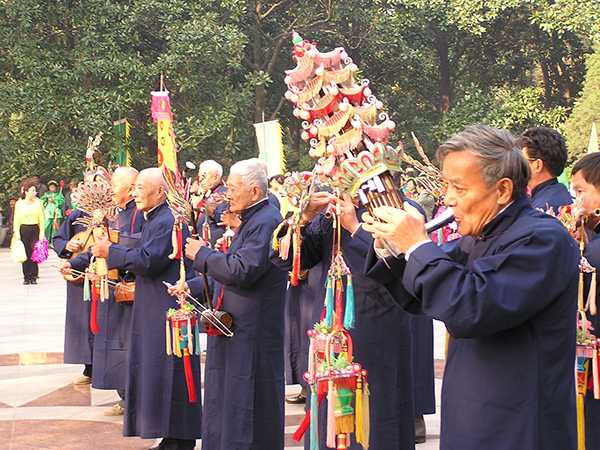
•"Sizhu" is usually performed during festivals at the Jiangnan region
According to the record, "sizhu" was popular at the downstream district of Changjiang river since 19th century. During the Jialong period of the Ming Dynasty, a large scale and systematic troupe was formed with Zhang Yetang as the leader. Using "gongchepu", the troupe specialized in performing "sizhu". Towards the end of Wanli period of the Ming Dynasty, "xiansuo" (normally refer to "sizhu" which was accompaniment of operas and "quyi"), a new musical form which could be seen as the predecessor of Jiangnan Sizhu, emerged at the Jiangsu district.
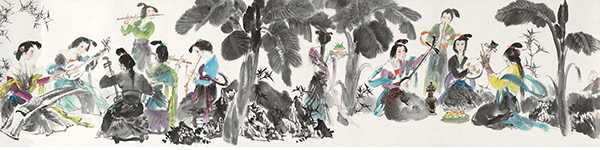
• Jiangnan Sizhu
After the Revolution of 1911 (Xinhai Revolution), "sizhu" developed in Southern China around Shanghai. At that time, a number of troupes emerged, including Wen Ming Ya Ji, Qing Ping She, Jun Tian She, Guo Le Yan Jiu She, etc. They facilitated the development of Jiangnan Sizhu and made it one of the special Chinese music genres.
Features
|
It is mainly organized by ensembles with less than 10 people. However, the number of people and instruments of the ensembles may sometimes change according to the actual circumstances and solo performance can also be done.
|
|
It is performed at home for self-entertaining, or is played at restaurants or banquets for boosting mood.
|
"Si" Stringed instruments like erhu, pipa, dulcimer, sanxian, etc.
"Zhu" Wind instruments like dizi, xiao, sheng, etc.
Others Percussion instruments like drum, clapper etc.
|
Variation Add different variation to basic melody, for example, "Zhong Hua Liu
Ban", "Man Liu Ban", "Huan Le Ge", "Yun Qing".
Circulated structure Similar to the rondo form of Western music like "Lao San
Liu", "Man San Liu".
Divertimento Use various qupai to perform a medley like "Si He Ru Yi", "Xing Jie".
|
Slowing down Change the tonal rhythm of the original song, for instance, add a
sub-beat between two beats to break one beat into two or even
four beats to enhance the structure of the song.
Ornamentation Add new melodic sound in between the original melodic sound to
enrich the melody.
|
Famous Work
| The following is the introduction of the Eight Great Pieces of Jiangnan Sizhu: |
[ Back to Top ] |
| Eight Great Pieces |
Original Song |
Introduction |
| Huan Le Ge |
"Huan Le Ge"
(The variation of the
original song) |
This song has used the variation techniques of slowing down and ornamentation and formed A1A2A musical form. The rhythm is lively and varied so it creates a joyful and cheerful atmosphere. |
| San Liu |
"San Liu", also known as "Mei Hua San Nong" or "Luo San Liu" |
According to the ornamentation of the performer, this song can be classified into three independent songs which are "Lao San Liu"(i.e. original song "San Liu"), "Zhong Ban San Liu" and "Hua Ban San Liu". The melody is vigorous and joyful since the main part of the song is formed by many tunes which are contrast to each other in modes and tempo. |
| Man San Liu |
This song is also known as "Hua San Liu" which uses variation techniques of slowing down and ornamentation on "San Liu". The melody is lively and creates a joyful atmosphere. |
| Zhong Hua Liu Ban |
"Liu Ban", also known as "Lao Liu Ban" |
This song is an independent song developed from the techniques of slowing down and ornamentation. The tempo gets slower and ornamented gradually and the music is fresh and smooth. |
| Man Liu Ban |
The tempo of this song is slower than "Zhong Hua Liu Ban". The melody is full of emotions. |
| Yun Qing |
"Si He" |
This song is developed from "Yun Qing Guang" in "Si He" and is also known as "Jing Xing Yun Qing", "Qing Yun Ban". It is divided into three parts: the first part is melodious and lyrical; the second part is lively and vigorous; and the third part is enthusiastic and exciting with a strong rhythm. |
| Si He Ru Yi |
This song is also known as "Qiao". "Si He" is the name of qupai which means that this song is formed by a number of qupai. Therefore, this is a synthesized song played by "sizhu". It starts with sanban and then uses manban with the techniques of slowing down and ornamentation. At the end of the song is a "sizhu" ensemble. The song is joyful and cheerful.
The song has a feature that there is solo performance by various kinds of "sizhu" one by one at the latter part of the song. The performer can improvise to show personal skills. |
| Xing Jie |
This song is also known as "Xing Jie Si He" which "Xing Jie" means to walk and perform in the streets so it is mainly used at wedding ceremony and temple fair. The song is divided into kuaiban and manban but both are adding variations to "Xing Jie". The melody is gradually faster to create a joyful and enthusiastic atmosphere like festivals. |
|
|